Your commercial floor takes a beating that a home garage never sees: forklift traffic, dropped tools, chemical spills, and constant foot traffic. When that concrete starts cracking, staining, or dusting, it slows your operation and looks bad to every customer who walks in. Choosing the right commercial epoxy flooring in Salt Lake City is how you stop the damage and get a surface built for the work you actually do.
The catch is that “epoxy” isn’t one product. A showroom floor and a warehouse floor face very different demands, and the wrong system fails fast. This guide breaks down the options by facility type, what drives performance, how long installation takes, and what moves your final impact.
Why Commercial Epoxy Flooring in Salt Lake City Needs More Than a Standard Kit
The thin epoxy kits sold at big-box stores are built for a weekend project, not a working facility. They cure into a thin film that chips under wheeled loads, peels when moisture pushes up through the slab, and yellows under Salt Lake City’s high-altitude UV exposure. On a busy floor, that failure shows up in months, not years.
Commercial-grade systems are engineered differently. They use high-solids or 100% solids resins, proper primers, and multiple layers measured in mils rather than a single thin coat. That build gives you the thickness and adhesion a demanding floor needs.
Utah’s climate adds a second layer of stress. Hot dry summers, cold snowy winters, and strong freeze-thaw cycling all push and pull on your slab, while winter de-icing salt tracks in on tires and boots. A coating that ignores those conditions cracks at the edges and delaminates. The right commercial concrete coating in Salt Lake City is matched to both the traffic and the weather.
Coating Options by Facility Type
There’s no single “best” floor. The smartest choice depends on what happens on top of it every day. Here’s how the main options line up by facility type.
| Facility | Common System | Priority |
|---|---|---|
| Warehouse / industrial | High-build epoxy + urethane topcoat | Impact & abrasion resistance |
| Showroom / retail | Metallic or flake epoxy | Appearance & easy cleaning |
| Auto / service garage | Flake epoxy + chemical-resistant topcoat | Chemical & hot-tire resistance |
Warehouses & Industrial
Warehouse floors live under forklifts, pallet jacks, and heavy racking. They need a thick, high-build epoxy with a urethane topcoat that shrugs off abrasion and point loads. Many operations add safety striping and non-slip aggregate to mark lanes and keep footing safe on smooth concrete.
If your slab is already worn or spalling, a concrete overlay can level and rebuild the surface before coating. Our industrial and warehouse flooring options are built around throughput, because every hour your floor is down is an hour you aren’t shipping. A durable warehouse floor coating in Utah pays for itself in fewer repairs and less dust.
Showrooms & Retail
A showroom floor sells for you. Here appearance leads, so metallic epoxy and decorative flake systems are popular for their depth, color, and clean high-gloss finish. These floors read as premium the moment a customer walks in.
They’re practical too. A sealed, seamless surface wipes clean, resists staining, and reflects light so your space feels brighter without extra fixtures. Polished concrete is another strong retail option when you want a lower-sheen, minimalist look that still holds up to traffic.
Auto & Service Garages
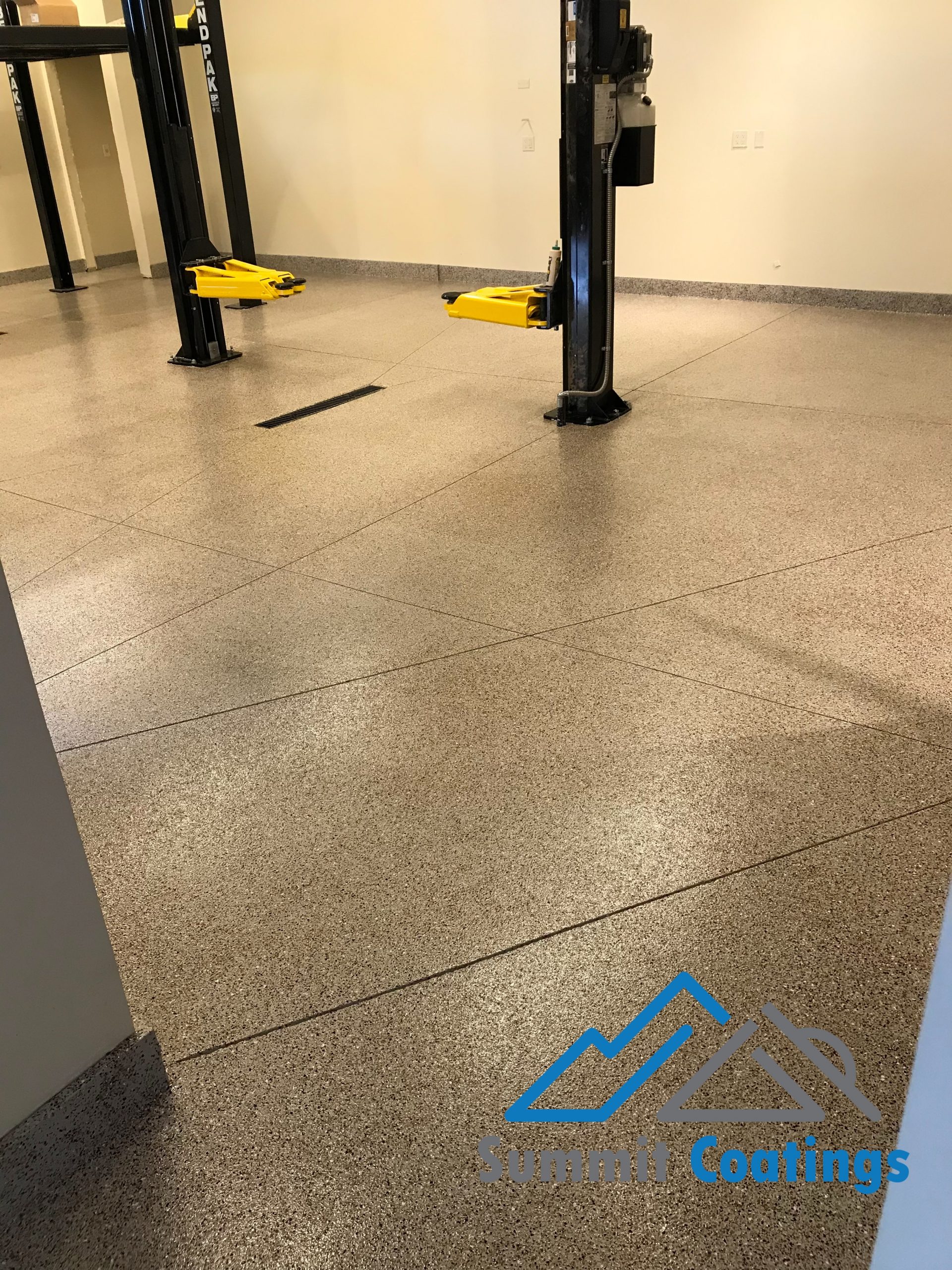
Auto shops and service bays face a specific enemy: hot tires, oil, brake fluid, and solvents. A standard coating softens under hot-tire pickup and stains under chemical exposure. Service-garage floors need a flake epoxy base with a chemical-resistant topcoat rated for automotive fluids.
Flake systems also hide dirt and add slip resistance, which matters on a floor that sees spills. The seamless surface means no grout lines or porous concrete trapping grime, so cleanup is a quick mop instead of a scrub. Explore the full range of epoxy coating systems to match your bay’s workload.
Durability, Chemical & Abrasion Resistance
Durability is where low-quality coatings and commercial systems part ways. The three resistances that matter most are abrasion, chemical, and impact, and each maps to a different topcoat choice.
- Abrasion resistance keeps the finish from wearing thin under constant traffic. Urethane topcoats hold up far longer than bare epoxy in high-traffic zones.
- Chemical resistance protects against oils, solvents, and cleaning agents that would etch or stain an unprotected floor.
- Impact resistance comes from film thickness. A thicker, high-build system absorbs dropped tools and heavy loads without chipping.
Utah’s freeze-thaw cycling deserves special attention. Water that seeps into concrete expands as it freezes, and repeated cycles pry coatings loose from a poorly prepped slab. Proper surface prep and the right primer are what keep a coating bonded through Salt Lake City winters. That’s also why concrete sealing matters on exterior and transitional surfaces exposed to road and de-icing salt.
The industry group behind concrete standards, the American Concrete Institute, publishes guidance on slab preparation and coating performance that reputable installers follow. The takeaway is simple: resistance is engineered into the system and the prep, not sprayed on at the end.
Downtime & Installation Timeline
For most facilities, downtime is the real impact of a new floor, so timeline planning matters as much as the coating itself. A typical commercial epoxy installation follows a predictable sequence.
- Surface prep (day one) uses diamond grinding or shot blasting to open the concrete so the coating can bond. This is the single most important step.
- Repairs and priming fill cracks and spalls, then seal the slab so later coats adhere evenly.
- Base and broadcast coats go down next, including flake or metallic media if your system calls for it.
- Topcoat and cure seals everything with the urethane or chemical-resistant finish, followed by cure time before traffic returns.
Total time depends on square footage, slab condition, and the number of coats, but most commercial projects run a few days from grind to walk-on. Foot traffic usually returns before full load-bearing traffic does, since heavy or wheeled loads need the coating fully cured.
Fast-cure systems can shorten this window when downtime is critical, and phased scheduling lets larger facilities keep part of the floor running while the rest is coated. If your operation can’t fully shut down, ask about weekend or off-hours installation when you request a quote.
What Affects Your Commercial Epoxy impact
Every commercial floor is quoted individually because the variables differ from one building to the next. Rather than a one-size number, your estimate reflects the specific conditions of your slab and your operation. These are the factors that move the service scope:
- Square footage. Larger floors lower the impact per square foot but raise the total. Layout complexity, columns, and tight corners add labor.
- Floor prep and slab condition. A clean, sound slab needs less work than one with cracks, spalling, oil saturation, or old coating that must be removed first.
- Coating system. A basic flake floor, a decorative metallic finish, and a heavy industrial urethane build each carry different material impacts.
- Moisture and vapor issues. Slabs pushing moisture may need a vapor-mitigation primer, which adds a step.
- Downtime constraints. Fast-cure products and off-hours or phased scheduling to keep you operating can affect the quote.
- Extras. Non-slip aggregate, safety striping, cove base, and integral drains each add scope.
Because these stack differently for every building, the only accurate number comes from a walkthrough. Our team assesses your slab and your workload before quoting, so you’re comparing real scope, not a guess. See the full lineup of commercial floor coating services to scope your project.
FAQ
How long does commercial epoxy flooring last?
A properly installed commercial system on a well-prepped slab lasts many years under heavy use. Lifespan depends on traffic, chemical exposure, and prep quality more than on the product label. Matching the system to your facility is what protects that longevity.
Can you coat over cracked or old concrete?
Usually, yes. Cracks and spalls are repaired and, when needed, a concrete overlay rebuilds a worn surface before coating. Slabs with deep structural damage are evaluated first, since a coating won’t fix an unstable base.
Will epoxy handle Utah’s freeze-thaw winters?
When the slab is prepped correctly and the right primer is used, yes. Proper surface preparation and a system matched to freeze-thaw cycling and de-icing salt are what keep the coating bonded through Salt Lake City winters.
which factors of my facility do you shut down during installation?
That depends on your timeline needs. Larger floors can be coated in phases so part of the operation keeps running, and fast-cure or off-hours scheduling further limits disruption. We plan the sequence around your operating hours.
Do you serve areas outside Salt Lake City?
Yes. Along with Salt Lake City, we serve Sandy, Draper, Lehi, Provo, Orem, Pleasant Grove, Mapleton, Vineyard, Park City, and the greater Salt Lake and Utah County area.
Ready to stop patching a floor that keeps failing? Get a free commercial epoxy flooring quote in Salt Lake City and we’ll assess your slab, your traffic, and your timeline before recommending a system. Request a free quote and Summit Coatings will build a floor made for the work you do.